SMEs: Your Sustainability Strategy Starts with Your Customer — Compliance Is Just One Tool.

Case study overview

  • Challenge: How can SMEs develop sustainability strategies that keep customer values at the center while effectively managing regulatory compliance requirements?
  • Research approach: field research with EU businesses, consumer behavior analysis, and expert interviews with marketing strategists specializing in purpose-led branding. 
  • Key Findings: 1/3 of customers stopped purchasing due to sustainability concerns; 34% trust brands more when certified by independent third parties; customer-driven approach proves more effective than compliance-first strategies.
  • Business Impact: SMEs that align their sustainability efforts with both regulatory compliance and customer expectations achieve better market positioning and can access new opportunities (public tenders, B2B partnerships, investor interest).

During a networking event, we met an interior designer. She was curious about making her business more sustainable. Throughout the entire conversation, she never asked about regulations or standards. She only had one focus : her customers.

And that made us think : what if we’ve been looking at things the wrong way ?

Lately, there’s been a lot of talk about EU sustainability legislations. Depending on who you ask:

  • The pessimists see recent EU decisions as the beginning of the end for corporate responsibility;
  • The optimists believe that corporate sustainability will remain, albeit differently. 

But in all these conversations, someone seems to be missing: the consumer. The conversation with the interior designer was a good reminder of that.

For many businesses, sustainability does not start with legislation and/or reporting. It begins with the client.

🎧 Prefer to listen?
If you’re on the go or just want to hear the article instead, press play below for the audio version. It’s a quick 7-minute dive into developing a sustainability strategy — perfect for busy days!

And market trends confirmed it. Consumers are very much aware that their purchasing decisions can drive sustainability shifts.

🔊 In 2023, 1/3 of customers stopped purchasing brands and products because of sustainability-related concerns

Gaining consumer’s trust is a necessary step in a company’s sustainability journey. Ex : for net-zero targets, consumers will trust a brand that reduces its emissions rather than a brand that relies on carbon offsets alone.
Accountability and clear transparent storytelling also need to be considered by businesses.

🔊 A third (34%) of consumers said that their trust in brands would be improved if they were recognized as an ethical or sustainable business by an independent third party

This article is a practical guide for SMEs who want to reach these customers – but are unsure of where to start when it comes to sustainability

1. Do you speak the sustainability language ?

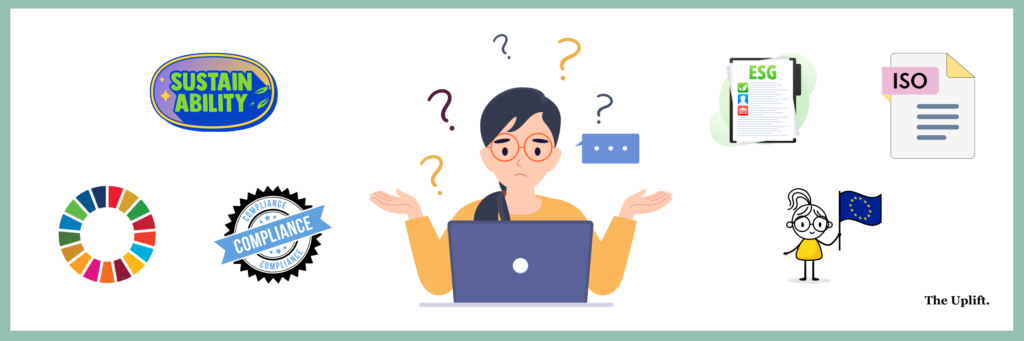
No worries, we get it, we’ve been there. Even today, we still have to Google some acronyms. Navigating the sustainability language can be challenging

So here’s a little reminder of some key notions in the sustainability space.

Sustainability vs. ESG : what’s the difference ?

Sustainability in business is about balancing profit with purpose: creating value while being socially and environmentally responsible. It involves understanding and managing the impact of your activities on the environment,  employees, supply chain, and local communities.

ESG stands for Environmental, Social, and Governance. It’s how companies measure and report their sustainability efforts. 

What are the UN SDGs ? Are they mandatory ?

The United Nations Sustainable Development Goals are a set of 17 global goals — like gender equality or affordable and clean energy — adopted by UN member states. They are not mandatory

However many companies use them as a framework to align their impact with global priorities

What about regulations ? Do they apply to me ?

If you’re working with larger companies — especially as a supplier, subcontractor, or manufacturer — and you’re based in the EU (or are a non-EU SME that wants to work with EU larger companies), there are regulations you should be aware of. 

Even if they don’t apply to you directly, they may affect you indirectly through procurement requirements.

🔊 Example  – The Corporate Sustainability Reporting Directive (CSRD) :

  • Requires large companies in the EU to report on their ESG risks and impacts ;
  • If you’re in their supply chain, they will ask you for your data. 

How to show my customers that I am committed to sustainability ?

While regulations may not directly apply to you, to prove your commitment to sustainability, you can adopt voluntary sustainability frameworks and standards

There are many standards/frameworks to choose from. How to choose the right one ? It will depend on your strategy, resources, and target audience.  

Let’s take the example of an EU-based company : 

1 – Your clients or investors are global – you might need to go the international framework road: 

Global Reporting Initiative

For structured sustainability reporting

Sustainability Accounting Standards Board

If you’re investor-focused

B Corp Certification

B Corp certification is a third-party certification for businesses that meet high standards of verified performance, accountability, and transparency.  It is verified by the non-profit organization, B Lab.

2- You’re focusing on the EU market

Voluntary Sustainability Reporting Standards

Ideal for SMEs working with larger companies under CRSD scope. 

ISO14001

Internationally recognized, but often required in public procurement and B2B contracts within the EU

B Corp Certification

B Corp certification is a third-party certification for businesses that meet high standards of verified performance, accountability, and transparency.  It is verified by the non-profit organization, B Lab.

🔊 You don’t feel ready yet to adhere to a voluntary framework ?

  • Use the UN SDGs as guiding goals; 
  • Publish a short sustainability statement; 
  • Show measurable progress.

2. What is your business purpose ? What value do you bring ?

From our experience, SMEs tend to fall into one of two camps regarding their sustainability practice

  • Those who tend to overestimate their sustainability actions
  • Those who tend to underestimate their sustainability actions 

🔊 Example: your workforce is composed of 50% women & 50% men ? Great news! You are working towards sustainability (gender equality is one of the SDGs)! 

So what to do ? Where to start ? How to know ?  Measure your impact & track it.

We know, entrepreneurs aren’t the biggest fans of measurement. But we’ve all heard the saying : “If it is not measurable, it does not exist”. Consider key indicators as your roadmap. For key indicators specific to sustainability, we’ll talk about key impact indicators (KII). Instead of getting overwhelmed by trying to measure everything, starting with 2-3 KIIs is already great.

🔊 Why it matters (for those fundraising): Did you know that some impact investors will require KII before reviewing your pitch deck ? In their eyes, no key impact indicators = no strategy

3. Visualize your impact : impact dashboard

Have you heard about the concept of vision boards ? An impact dashboard works the same way. 

The impact dashboard is here to help you monitor metrics, visualize progress, and make informed decisions. Just like a vision board, your impact dashboard will evolve with time. You don’t measure just for the love of metrics. You measure to grow your business.  

4. Value co-creation - Emphasis on collaboration and partnership

🔊“If you want to go fast, go alone. If you want to go far, go together”. 

Today, sustainability is a shared priority across industries

Whether you are a manufacturer, retailer, or service provider, you are part of a system. The sustainable solution or agenda you work on will also benefit your stakeholders: suppliers, clients, and even competitors. That’s the power of value co-creation.

By working together upstream or downstream in your value chain, or even horizontally with industry competitors, you can create new business opportunities, reduce development costs, and scale your impact more efficiently. It’s not just about doing business with others; it’s about forming strategic partnerships for a sustainable and resilient future for all.

Let’s go back to the opening example of the interior designer using recycled materials : 

  • This opens doors to public tenders that increasingly require the use of recycled content. It also aligns with growing client expectations, making her services more attractive to sustainability-conscious customers. 
  • Upstream, material suppliers seek designers to pilot and showcase their circular innovations. By collaborating with these suppliers, the designer can gain early access to new materials, co-develop applications, and even shape future product development. 

5. Communication, marketing and storytelling

Sorry to break it to you. 

Doing great things regarding sustainability is not enough. You have to communicate about it

Great news : communication is easier than you think. It’s about one thing :  sharing your business journey.  

But as marketing strategist Jean-Éric Delarosbil – General Director and senior marketing strategist at Squalls, a Canadian agency specializing in purpose led-branding  – reminds us, even sharing your sustainability journey requires structure :  

🔊« What truly resonates with audiences today is not just what a company does or says, but the coherence between its actions, its messages, and the tangible change it brings to its customers and within its ecosystem.

 At Squalls, we believe that sustainability should be the heart of strategic positioning and branding; not as a passing campaign or communication theme, but as a continuous narrative that weaves together identity, customer experience, and long-term value creation.

 SMEs don’t need every certification on the market to make a meaningful impact. What they do need is the ability to clearly articulate why they exist, who they serve, and how their business model contributes to lasting, positive change, even in small ways. The true strength of storytelling lies in its ability to show not only what a brand offers, but the difference it creates”. 

Once again, no need to start big on marketing and communication: does your “About Us” company page sound like a resume or does it mention your sustainability journey ? If it is the former, this is where you can start. 

Did you know that the About Me page is one of the most visited pages on a website ? 

Conclusion

The companies that will be the leaders in the market are the companies that understand that sustainability is more than a compliance exercise. It is an innovation opportunity and therefore, a competitive advantage. 

Sustainability represents a new economy in response to today’s planetary, societal and social urgencies. Like any major shift, it opens up new opportunities

  • To rethink value, 
  • Respond to evolving customer expectations; 
  • and stay ahead of the competition.

It starts with understanding what your customers care about and how your business can respond with purpose. Today, customers aren’t just buying products—they buy into values and solutions for a livable planet tomorrow. 

This is why businesses must show tangible examples of how their innovations support customer choices and enable them to respond to urgencies. Your business can make your customers the heroes of this transition.

Regulations and standards should not be seen as burdens but as frameworks: shared languages that help guide operational adaptation, strengthen resilience, and foster trust through transparency.

Your sustainability journey starts here—and it starts with you.

So ask yourself: What matters to my customers? And how can my business lead with purpose?

🔊Want to be like that interior designer?

Learn how to put customer values at the center of your sustainability strategy with our Interior Designer Method workshop .

This workshop is built on real customer insights – so you’re not guessing what matters to them.

Sources

About the authors

Laisser un commentaire

Votre adresse e-mail ne sera pas publiée. Les champs obligatoires sont indiqués avec *